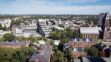
The Harvard Department of Mathematics at Its Best
We are pleased to bring you this short documentary exploring the depth and creativity of our department. Special thanks to everyone who was part of...
Read more
We are pleased to bring you this short documentary exploring the depth and creativity of our department. Special thanks to everyone who was part of...
Read more
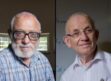
The Wolf Foundation named two former Harvard math professors 2026 Wolf Prize Laureates in Mathematics. Joseph Bernstein and David Kazhdan share the prize for their...
Read more
On September 17–18, 2026 a group of 24 mathematicians met at Harvard to grapple with the changing landscape for mathematics PhD programs in the age...
Read more
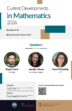
CMSA MEMBER SEMINAR
AI for the working mathematician, CMSA EVENTS
HARVARD-MIT ALGEBRAIC GEOMETRY
CMSA NEW TECHNOLOGIES IN MATHEMATICS
INFORMAL SEMINAR ON DYNAMICS, GEOMETRY AND MODULI SPACES
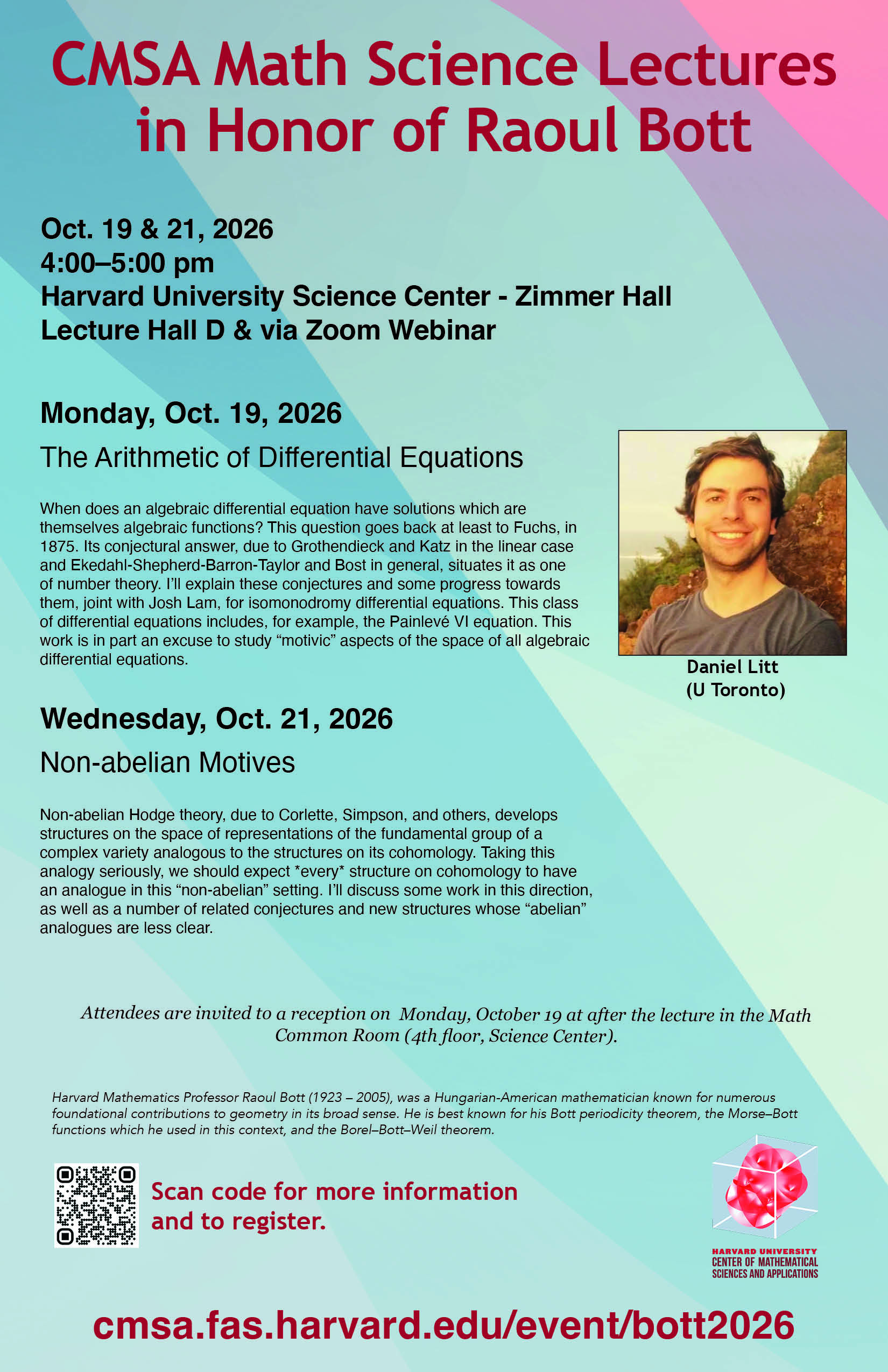
CMSA EVENTS
CMSA Q&A Seminar
CMSA EVENTS
CMSA EVENTS
CMSA COLLOQUIUM
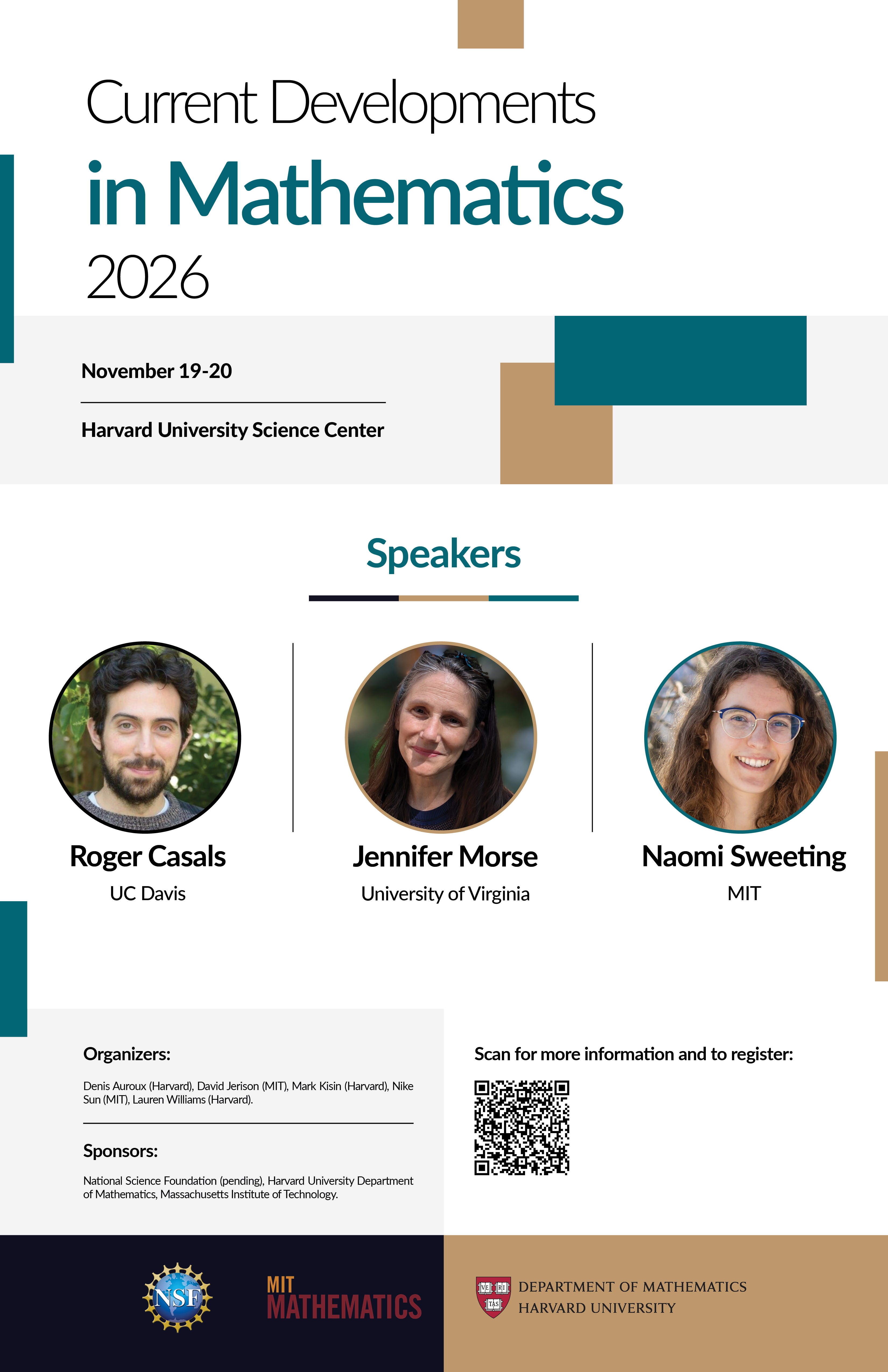
ANNOUNCEMENTS, CONFERENCES
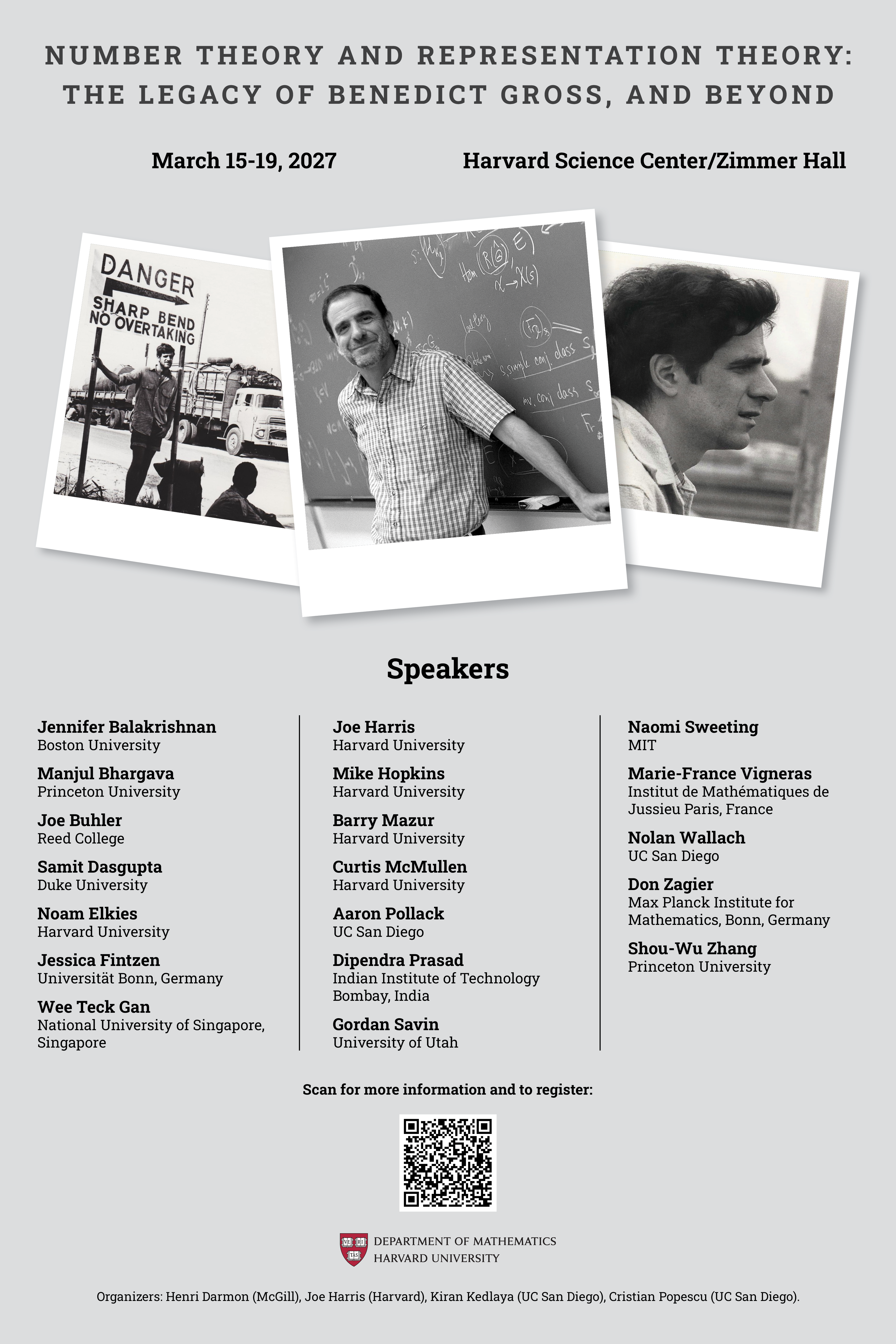
CONFERENCES
|
Monday
|
Tuesday
|
Wednesday
|
Thursday
|
Friday
|
Saturday
|
Sunday
|
|---|---|---|---|---|---|---|
3 events,CMSA EVENTS
CMSA Workshop on Lagrangian Floer theory and applicationsWhen: September 28, 2026 - October 2, 2026
8:00 am - 5:00 pm
Where: CMSA, 20 Garden St, G10
HARVARD-MIT COMBINATORICSHARVARD-MIT COMBINATORICS
Richard P. Stanley Seminar in Combinatorics: Learning Functions of HalfspacesWhen: September 28, 2026
3:00 pm - 4:00 pm
Where: MIT Room 2-143
Speaker: Shyamal Patel (Columbia University)
CMSA COLLOQUIUMCMSA COLLOQUIUM
CMSA Colloquium: Life on a Noisy Seascape: Extinction, Growth, and DiversityWhen: September 28, 2026
4:30 pm - 5:30 pm
Where: CMSA, 20 Garden St, G10
Speaker: Mehran Kardar (MIT)
|
2 events,GEOMETRY AND QUANTUM THEORYGEOMETRY AND QUANTUM THEORY
Geometry and Quantum Theory Seminar: From Markov processes to path integralsWhen: September 29, 2026
4:15 pm - 6:30 pm
Where: Science Center 507
Speaker: Tomer Schlank (Harvard)
|
7 events,CMSA Q&A SeminarCMSA Q&A Seminar
CMSA Q&A Seminar: What is Lagrangian Floer homology?When: September 30, 2026
12:00 pm - 1:00 pm
Where: CMSA, 20 Garden St, Common Room
Speaker: Denis Auroux (Harvard University)
NUMBER THEORYNUMBER THEORY
Number Theory Seminar: Zig-Zag holds for Galois representationsWhen: September 30, 2026
3:00 pm - 4:00 pm
Where: Science Center 507
Speaker: Eknath Ghate (Tata Institute of Fundamental Research)
INFORMAL SEMINAR ON DYNAMICS, GEOMETRY AND MODULI SPACESINFORMAL SEMINAR ON DYNAMICS, GEOMETRY AND MODULI SPACES
Algebraic geometry of earthquakesWhen: September 30, 2026
4:00 pm - 5:00 pm
Where: Science Center 530
Speaker: Curtis McMullen (Harvard)
|
3 events,THURSDAY SEMINARTHURSDAY SEMINAR
Thursday Seminar: Quasicoherent sheaves of higher categoriesWhen: October 1, 2026
3:30 pm - 5:30 pm
Where: Science Center 507
Speaker: Jeremy Hahn
CMSA GEOMETRY AND MATHEMATICAL PHYSICS SEMINAR, CMSA EVENTSCMSA GEOMETRY AND MATHEMATICAL PHYSICS SEMINAR, CMSA EVENTS
CMSA Geometry and Mathematical Physics Seminar: Skein valued curve counts and associativesWhen: October 1, 2026
4:30 pm - 5:30 pm
Where: CMSA, 20 Garden St, G10
Speaker: Tobias Ekholm (Uppsala)
|
3 events,CMSA MEMBER SEMINARCMSA MEMBER SEMINAR
CMSA Member Seminar: Painlevé VI: the search for canonical representationsWhen: October 2, 2026
12:00 pm - 1:00 pm
Where: CMSA, 20 Garden St, Common Room
Speaker: Aaron Landesman (Harvard)
GAUGE THEORY AND TOPOLOGYGAUGE THEORY AND TOPOLOGY
Gauge Theory and Topology Seminar: Nearly-parallel $G_2$-structures in different homotopy classesWhen: October 2, 2026
3:30 pm - 4:30 pm
Where: Science Center 507
Speaker: Artem Aleshin (Stony Brook University)
|
0 events,
|
0 events,
|
4 events,CMSA EVENTSCMSA EVENTS
CMSA Special Seminar: A physical interpretation of recent singularity theoremsWhen: October 5, 2026
1:30 pm - 3:00 pm
Where: CMSA, 20 Garden St, G10
Speaker: Michael Brenner (Harvard and Google)
RICHARD P. STANLEY SEMINAR IN COMBINATORICS, HARVARD-MIT COMBINATORICSRICHARD P. STANLEY SEMINAR IN COMBINATORICS, HARVARD-MIT COMBINATORICS
Richard P. Stanley Seminar in Combinatorics: Off-diagonal hypergraph Ramsey numbersWhen: October 5, 2026
3:00 pm - 4:00 pm
Where: MIT Room 2-143
Speaker: Xiaoyu He (Georgia Tech)
CMSA COLLOQUIUMCMSA COLLOQUIUM
CMSA Colloquium: Spectral Methods for signal recovery in multi-modal problemsWhen: October 5, 2026
4:30 pm - 5:30 pm
Where: CMSA, 20 Garden St, G10
Speaker: Subhabrata Sen (Harvard Statistics)
|
2 events,HARVARD-MIT ALGEBRAIC GEOMETRYHARVARD-MIT ALGEBRAIC GEOMETRY
Harvard-MIT Algebraic Geometry Seminar: Bounds on the Mordell-Weil rank of certain elliptic fibrationsWhen: October 6, 2026
3:00 pm - 4:30 pm
Where: Science Center 507
Speaker: Antonella Grassi (University of Bologna)
GEOMETRY AND QUANTUM THEORYGEOMETRY AND QUANTUM THEORY
Geometry and Quantum Theory Seminar: Markov processes and path integrals continuedWhen: October 6, 2026
4:15 pm - 6:30 pm
Where: Science Center 507
Speaker: Ahsan Khan (Harvard University)
|
4 events,CMSA Q&A SeminarCMSA Q&A Seminar
CMSA Q&A Seminar: What is a virtual fundamental cycle? (ICM Series: On the work of John Pardon)When: October 7, 2026
12:00 pm - 1:00 pm
Where: CMSA, 20 Garden St, Common Room
Speaker: Shaoyun Bai (MIT)
NUMBER THEORYNUMBER THEORY
Number Theory Seminar: The quest for elliptic curves of high rankWhen: October 7, 2026
3:00 pm - 4:00 pm
Where: Science Center 507
Speaker: Noam Elkies (Harvard)
INFORMAL SEMINAR ON DYNAMICS, GEOMETRY AND MODULI SPACESINFORMAL SEMINAR ON DYNAMICS, GEOMETRY AND MODULI SPACES
Simple geodesics on a hyperbolic torusWhen: October 7, 2026
4:00 pm - 5:00 pm
Where: Science Center 530
Speaker: Rafael Saavedra (Harvard)
|
2 events,THURSDAY SEMINARTHURSDAY SEMINAR
Thursday Seminar: Quasicoherent sheaves of higher categories IIWhen: October 8, 2026
3:30 pm - 5:30 pm
Where: Science Center 507
Speaker: Jonathan Buchanan
CMSA GEOMETRY AND MATHEMATICAL PHYSICS SEMINAR, CMSA EVENTSCMSA GEOMETRY AND MATHEMATICAL PHYSICS SEMINAR, CMSA EVENTS
CMSA Geometry and Mathematical Physics Seminar: Towards a Hodge theoretic mirror symmetry for punctured surfacesWhen: October 8, 2026
4:30 pm - 5:30 pm
Where: CMSA, 20 Garden St, G10
Speaker: John Alexander Cruz Morales (Universidad Nacional de Colombia)
|
2 events,CMSA MEMBER SEMINARCMSA MEMBER SEMINAR
CMSA Member Seminar: Quantum Cellular Automata and K theory – *CANCELLED*When: October 9, 2026
12:00 pm - 1:00 pm
Where: CMSA, 20 Garden St, Common Room
Speaker: Bowen Yang (Harvard)
AI for the working mathematician, CMSA EVENTSAI for the working mathematician, CMSA EVENTS
CMSA Seminar AI for the working mathematician: Large HypercubesWhen: October 9, 2026
4:30 pm - 5:30 pm
Where: CMSA, 20 Garden St, G10
Speaker: Jordan Ellenberg (University of Wisconsin–Madison)
|
0 events,
|
0 events,
|
|
0 events,
|
1 event,HARVARD-MIT ALGEBRAIC GEOMETRYHARVARD-MIT ALGEBRAIC GEOMETRY
Harvard-MIT Algebraic Geometry Seminar: Intersection Cohomology of p-adic Shimura VarietiesWhen: October 13, 2026
3:00 pm - 4:00 pm
Where: Science Center 507
Speaker: Linus Hamann (Harvard University)
|
2 events,CMSA NEW TECHNOLOGIES IN MATHEMATICSCMSA NEW TECHNOLOGIES IN MATHEMATICS
CMSA New Technologies in Mathematics Seminar: ProvezMe: Formalizing Fermat Last Theorem and BeyondWhen: October 14, 2026
2:00 pm - 3:00 pm
Where: Virtually
Speaker: Tianyi Peng (Columbia Business School)
INFORMAL SEMINAR ON DYNAMICS, GEOMETRY AND MODULI SPACESINFORMAL SEMINAR ON DYNAMICS, GEOMETRY AND MODULI SPACES
Polynomial bounds for eigenfunctions and eigenvalues on random covers of hyperbolic surfacesWhen: October 14, 2026
4:00 pm - 5:00 pm
Where: Science Center 530
Speaker: Elena Kim (Harvard)
|
0 events,
|
0 events,
|
0 events,
|
0 events,
|
1 event,CMSA EVENTSCMSA EVENTS
CMSA Math Science Lectures in Honor of Raoul Bott | Daniel Litt, Benedict H. Gross Distinguished Visitor, Harvard Mathematics DepartmentWhen: October 19, 2026
4:00 pm - 5:00 pm
Where: Science Center Hall D
Speaker: Daniel Litt (Benedict H. Gross Distinguished Visitor, Harvard Mathematics Department)
|
0 events,
|
2 events,CMSA Q&A SeminarCMSA Q&A Seminar
CMSA Q&A Seminar: What is a self-concordant barrier function?, and what is an accelerated first-order algorithm? (ICM Series: On the work of Yurii Nesterov)When: October 21, 2026
12:00 pm - 1:00 pm
Where: CMSA, 20 Garden St, Common Room
Speaker: Robert M. Freund (MIT)
CMSA EVENTSCMSA EVENTS
CMSA Math Science Lectures in Honor of Raoul Bott | Daniel Litt, Benedict H. Gross Distinguished Visitor, Harvard Mathematics DepartmentWhen: October 21, 2026
4:00 pm - 5:00 pm
Where: Science Center Hall D
|
0 events,
|
0 events,
|
0 events,
|
0 events,
|
|
0 events,
|
0 events,
|
0 events,
|
0 events,
|
0 events,
|
0 events,
|
0 events,
|